If you’re planning a Bay Area wedding, the entertainment decision usually comes down to one question: do you want a DJ, a live band, or a hybrid that gives you a little of both?
There’s no single “right” answer. The best choice depends on your guest list, your venue logistics, your tolerance for schedule constraints, and the kind of energy you want on the dance floor. The good news: in the Bay Area, you have excellent options across all styles — but the price ranges (and the hidden line items) can surprise people.
Below is a practical, Bay Area-specific comparison: what you’ll likely pay in 2026, what each option does well, where couples get tripped up, and how to make the decision without overthinking it.
Quick decision guide (for Bay Area weddings)
Choose a DJ if:
- You want maximum song variety (from Bollywood to Bad Bunny to Bay classics) and smooth transitions.
- Your venue has tight load-in rules (SF hotels, city venues) or limited stage space.
- You care about keeping the night moving: grand entrance, toasts, dances, and a packed dance floor.
Choose a live band if:
- You want a “show” feel and live-performance energy.
- Your crowd loves dancing to classics, funk, soul, pop, and sing-along moments.
- You have space (and sound allowances) for a stage setup.
Choose a DJ + live elements (sax, percussion, strings, etc.) if:
- You want the flexibility of a DJ but the “wow” moment of live performance.
- You’re hosting a larger reception (or you care about peak dance-floor energy).
What a wedding DJ costs in the Bay Area (2026)
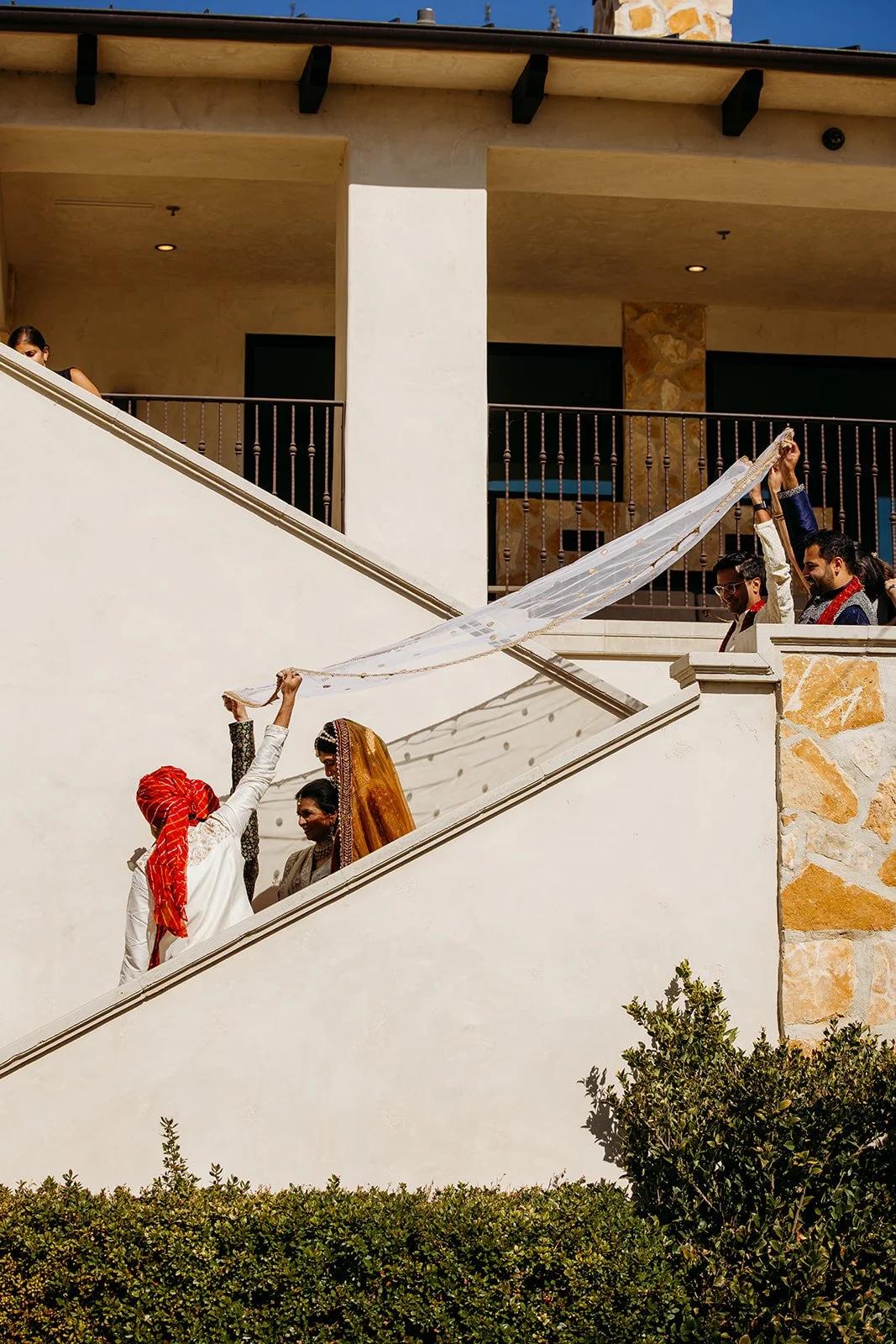
In the Bay Area, a professional wedding DJ typically comes as an all-in-one entertainment lead: music, MC duties, timeline management, and coordination with your planner and venue.
A useful reality check is to look at local, publicly listed packages. Second Song (a San Francisco/Bay Area DJ company) lists DJ/MC packages at $2,195 (“The Party Only”), $2,695 (“Full Wedding”), and $3,195 (“All Day All Night”), with tax, travel, setup, and breakdown included.
Across the broader market, pricing tiers often break down like this:
Typical Bay Area DJ price ranges
- $1,000–$1,500: entry-level or newer wedding DJs (usually basic sound, minimal lighting, less hands-on MC work)
- $1,500–$3,000: solid professional DJs with strong reviews and dependable gear
- $3,000–$7,000+: high-demand DJs and premium productions (more lighting, effects, multiple locations, deeper planning support)
You’ll see weekend peak-season Saturdays (roughly May–October in the Bay Area) at the higher end, especially in Napa/Sonoma or for multi-location weddings that require multiple sound setups.
Common DJ add-ons that change the budget
Even if your “DJ fee” looks straightforward, the total can change with:
- Multiple setups (ceremony + cocktail hour + reception in different spaces)
- Lighting (uplights, dance lighting, intelligent/DMX lighting)
- Photo booth (often a separate line item)
- Special effects (cold sparklers, dancing-on-a-cloud, CO2 cannons)
- After-party hours (late-night extensions)
Tip: ask for a quote that’s explicit about how many locations are covered and whether the DJ is bringing backup gear (especially if you’re on the coast, in the redwoods, or in wine country where load-in can be long).
What a live wedding band costs in San Francisco and the Bay Area
Bands vary wildly because you’re paying for multiple skilled performers, rehearsal time, and production logistics.
A broad baseline: FixTheMusic notes that most professional San Francisco wedding bands range from $2,000 to $6,000, with premium acts and larger showbands costing more.
In practice, the number that matters is: how many musicians, how long they play, and what production is included.
What often drives band pricing (Bay Area realities)
- Band size: a 3–4 piece band can feel intimate; a 7–10 piece showband feels like a concert.
- Performance time: many bands don’t play nonstop for 4–5 hours; they’ll play sets with breaks.
- Production: some bands provide full sound (PA, mics, sound engineer); others assume your venue or a separate vendor will.
- Travel/logistics: Bay bridges, SF load-ins, and Napa/Sonoma distances can all add time and cost.
If you love the idea of a band but worry about “dead air,” the cleanest solution is often a DJ (or band-provided playlist) for breaks, with the band taking the big prime-time sets.
Vibe differences: what guests actually feel
This is where couples get the most value from thinking beyond price.
DJs: the advantage is flow and variety
A great wedding DJ can:
- Blend genres across generations (and across cultures)
- Build energy without awkward pauses
- Handle announcements cleanly (or keep them minimal, if that’s your style)
- Pivot instantly based on the room
If your guest list is mixed — think: 20-somethings + aunties + coworkers + college friends — DJs have a big advantage in flexibility.
Bands: the advantage is “event” energy
A good band can:
- Turn even casual dancers into “one more song” people
- Create unforgettable live moments (horn hits, sing-alongs, crowd interaction)
- Make dinner and cocktail hour feel elevated when the band is also doing jazz/soul sets
Bands shine when your venue can handle the sound and when your guests like the same kind of music. If you want 90s hip-hop into K-pop into EDM, a band is usually not the best fit.
Logistics that matter in the Bay Area (and can quietly decide for you)
1) Space and power
SF venues, historic properties, and many wine country sites have strict rules about:
- Stage dimensions
- Power access
- Where vendors can load in and park
If your reception space is tight, a DJ setup can be dramatically easier.
2) Sound limits and curfews
Outdoor venues (especially in residential-adjacent areas) can have noise restrictions. Bands can absolutely be respectful — but they are harder to control than a DJ system, and they usually take longer to soundcheck.
3) Timeline complexity
If you have:
- A cultural ceremony with specific music cues
- Multiple speeches
- A choreographed first dance
- A surprise performance
A DJ often functions as the “audio producer” who can manage these cues smoothly. Bands can do it too, but it requires more coordination and, ideally, a clear plan in advance.
The hybrid option: DJ + live musicians
This is increasingly popular in the Bay Area because it solves a real problem: couples want the flexibility of a DJ and the visual, high-energy punch of live music.
Examples of live elements couples add:
- Sax player during cocktail hour and dance floor sets
- Live percussion layered over a DJ
- String trio for ceremony + DJ for reception
Second Song, for example, lists DJ + live fusion options like a “Signature 3 Musicians” dancing package and larger DJ + live configurations — the point being: you can scale this up from “a little live flavor” to “full production.”
If you’re torn between DJ and band, this is often the most cost-effective way to get “band-like” excitement without paying for (or making room for) an 8-piece group all night.
A realistic budget framework (how to compare quotes)
When you compare options, try to normalize quotes into the same categories:
Entertainment quote checklist
- Total hours of coverage (and what counts as coverage)
- Ceremony audio included or separate?
- Cocktail hour audio included or separate?
- Reception audio + microphones (toasts) included?
- Number of locations/setups included
- Lighting included (and exactly what)
- Break music (for bands)
- Overtime rate
Then ask yourself one final question that’s surprisingly clarifying:
“What do we want people to say about the reception?”
If you want: “We danced all night,” lean DJ (or DJ + live). If you want: “That band was unreal,” go band.
Bottom line
For many Bay Area couples, a DJ is the best blend of flexibility, timeline control, and predictable logistics — and it typically costs less than a full band. Bands are unbeatable for live energy, but they’re more sensitive to venue constraints and usually require more production planning.
If you’re stuck, pick entertainment based on your guest list and venue realities first, then your music taste second. The best wedding receptions in the Bay Area aren’t the ones with the most expensive entertainment — they’re the ones where the entertainment matches the room.